

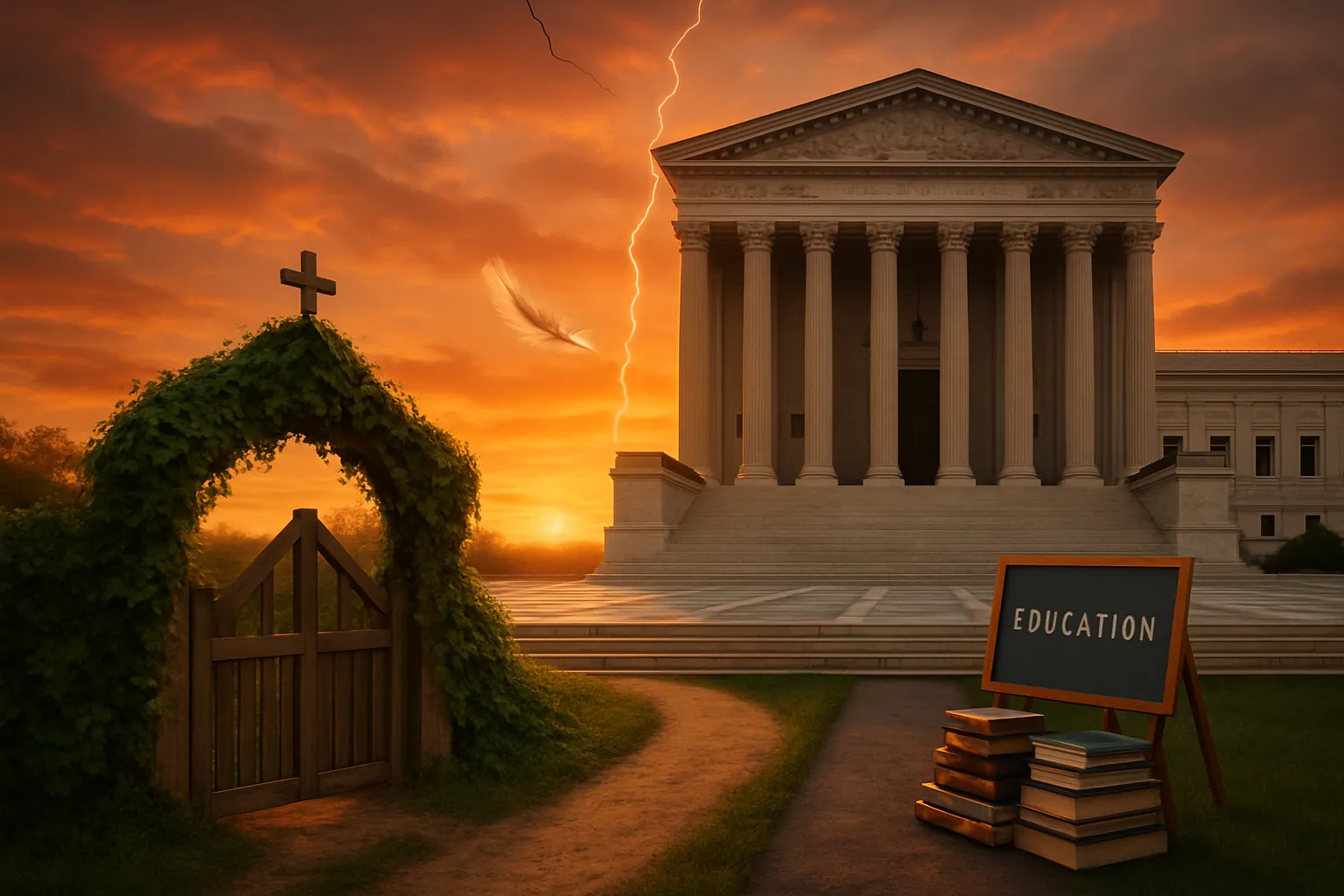
Supreme Court Deadlock Halts Religious Charter School Plan
The U.S. Supreme Court’s recent 4-4 split decision effectively blocked Oklahoma’s attempt to establish St. Isidore of Seville Catholic Virtual School, the nation’s first taxpayer-funded religious charter school, leaving intact a lower court ruling that deemed the plan unconstitutional. This landmark case represented a significant legal test concerning the constitutional separation of church and state, specifically related to taxpayer-funded education.
Justice Amy Coney Barrett recused herself from participating in the case, reportedly due to her friendship with a professor at the University of Notre Dame, who had advised on the school’s formation. With only eight justices participating, the evenly divided ruling underscored deep ideological divisions over religious liberties and public funding. As a result, the ruling maintains the Oklahoma Supreme Court’s earlier decision that the religious charter school would violate the Establishment Clause of the U.S. Constitution, which prohibits government actions that unduly favor one religion over another.
The proposed online school, sponsored by the Catholic Archdiocese of Oklahoma City and the Diocese of Tulsa, aimed initially to serve approximately 500 students, with plans to expand enrollment to around 1,500 by 2028. About half of the projected students were expected to come from lower-income households, benefiting from access to religiously-centered education via public funding. However, opponents argued that taxpayer funding for a religious institution fundamentally violates the principles underpinning public education.
Oklahoma Governor Kevin Stitt and State Superintendent Ryan Walters criticized the Supreme Court decision, characterizing it as discriminatory against religious institutions. Conversely, the decision was praised by Oklahoma Attorney General Gentner Drummond, who emphasized his commitment to ensuring taxpayer dollars are not used to fund religious education, expressing particular concern over possible future requests from religious schools of various faiths, which he described as potentially ‘radical.’
“I’m committed to protecting religious liberty. What I’m not for is taxpayer dollars funding religious indoctrination, especially groups that may espouse extremist ideologies,” Attorney General Drummond wrote on his social media account.
Detailed Chronology and Reactions
The case originated in the Oklahoma courts after the Oklahoma Statewide Virtual Charter School Board approved an application from the Catholic dioceses in June 2023. This authorization faced immediate legal challenges, culminating in the Oklahoma Supreme Court’s ruling that the planned charter school’s curriculum, overtly religious in nature, constituted excessive entanglement between the state and religion.
Representatives from Alliance Defending Freedom, a conservative legal group arguing on behalf of the Catholic dioceses, claimed that barring religious institutions from such charter programs amounted to discrimination. They also noted that, due to the Supreme Court’s tie, no national precedent was set, leaving the issue of publicly funded religious charter schools unresolved at the federal level and ripe for further litigation.
Chief Justice John Roberts, in earlier discussions, acknowledged that charter schools differ substantially from existing school voucher programs, which typically provide families public funds to attend private religious or secular schools. Roberts pointed out that charter schools operate under greater governmental oversight and accountability, raising constitutional complications when religious teachings are integrated directly into publicly funded curriculums.
“There is indeed significant governmental control over charter schools… which complicates the constitutional analysis regarding religious establishments,” Chief Justice Roberts commented during earlier deliberations.
Legal analysts emphasize that the unresolved nature of the issue due to the Supreme Court’s current deadlock means this matter may soon return for definitive resolution, particularly considering the expanding nationwide prevalence of charter school programs.
Impacting Oklahoma significantly, this decision has larger implications for the future of educational funding and religiously affiliated institutions, creating uncertainty among states considering similar programs.
Historical Context and Broader Implications
Historically, the Establishment Clause of the First Amendment has been interpreted by U.S. courts to maintain a strict separation between church and state, particularly in educational contexts. Landmark Supreme Court cases, such as Engel v. Vitale (1962), which prohibited state-sponsored prayer in public schools, and Lemon v. Kurtzman (1971), which created a three-pronged test to evaluate governmental involvement in religious institutions, have traditionally reinforced this separation.
Recent trends, however, have seen increasing challenges and nuanced reinterpretations of this separation, particularly from conservative legal groups advocating for broader religious liberty protections. Notably, the Supreme Court’s 2022 decision in Carson v. Makin allowed religious schools to participate in Maine’s publicly funded tuition assistance program, underlining shifting judicial perspectives toward increased accommodation of religious institutions in publicly funded educational programs.
Oklahoma’s blocked attempt is the latest chapter in this evolving legal saga. The decision, although not definitive nationwide due to the Supreme Court’s deadlock, serves as an indicator of potential shifts in judicial standards for church-state separation, especially where education funding is concerned. Education advocates express concern that approving a taxpayer-funded religious charter school could blur governmental neutrality regarding religion and set a precedent encouraging numerous similar cases nationwide.
Further, the case exemplifies ongoing political divisions on church-state issues. Proponents, often aligned politically with conservative Republican policymakers, argue for expanded religious liberty and parental choice in education. Opponents, typically aligning with secular advocacy groups and many civil libertarians, warn against the erosion of constitutional protections that guard against state-endorsed religion.
This latest decision underscores the deeply contested interpretations surrounding the First Amendment’s Establishment Clause, leaving unresolved how far states can extend taxpayer support to religious-affiliated educational institutions. Given the stakes, legal experts anticipate continued litigation challenging established church-state separation principles in various educational settings across the nation, ensuring that Oklahoma’s blocked religious charter school will remain a focal point of significant legal and educational debates moving forward.