

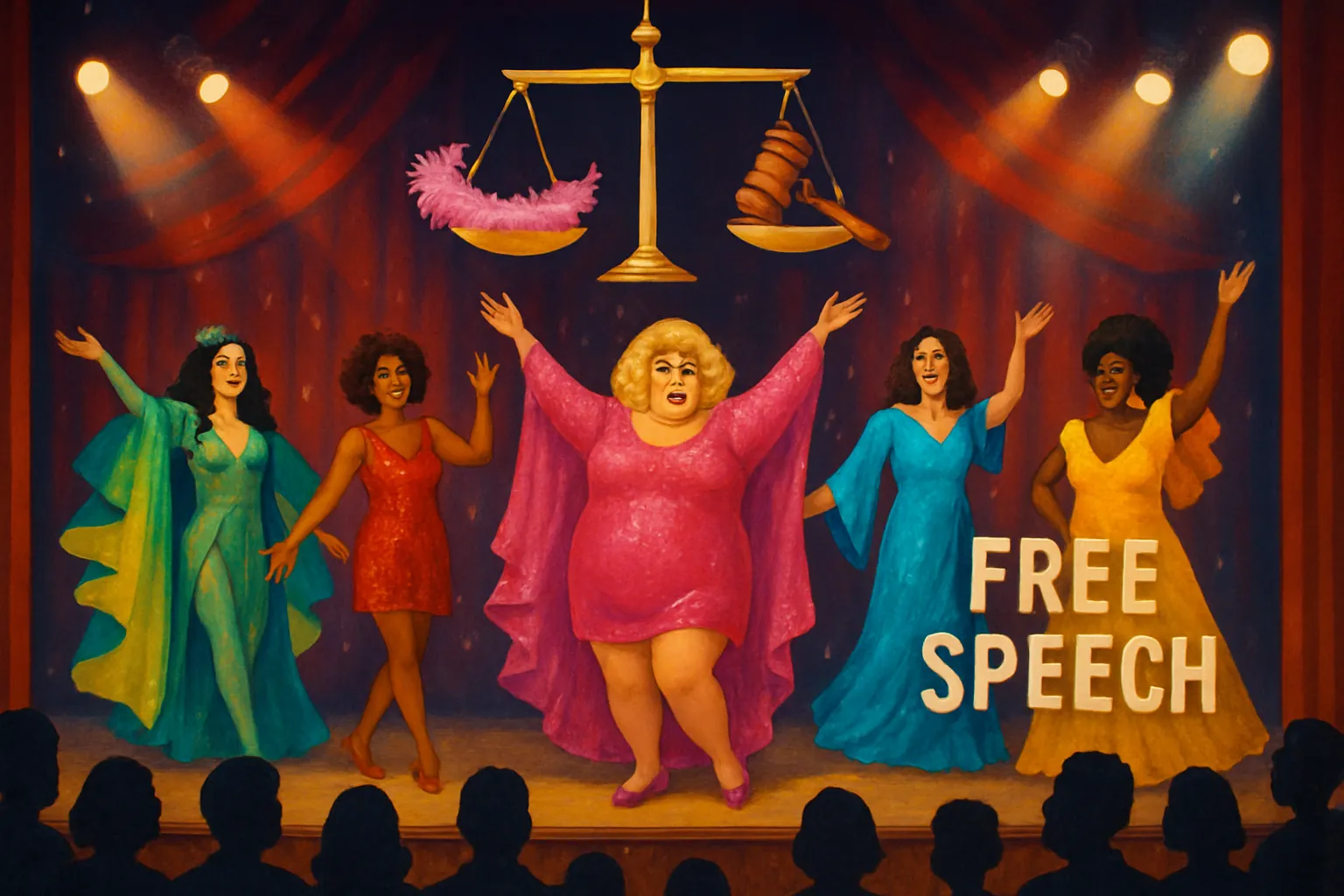
Federal Courts Uphold Protections for Drag Performances in Florida
A federal judge has determined that restrictions on drag performances in Naples, Florida, are likely unconstitutional, asserting that such performances are protected under the First Amendment. The ruling specifically allows the Naples Pride event, scheduled to take place outdoors at Cambier Park, to proceed without age restrictions or location constraints set by city officials. Judge John Steele of the Middle District of Florida issued a preliminary injunction against the city of Naples, finding that prior restrictions—including age and indoor performance mandates—violated constitutional protections.
The ruling explicitly noted that the city’s permitting policies were “clearly invalid” under the First Amendment. Steele emphasized that the drag event constituted symbolic speech, inherently expressive due to its message of LGBTQ+ pride and visibility. The Naples City Council and police had initially approved the event’s permit but had required performances to be held indoors with an age minimum of eighteen. Steele’s decision effectively nullifies these stipulations, reaffirming the event’s constitutional protections.
Naples Pride organizers praised the decision, highlighting its significance for the LGBTQ+ community. “This is not just a victory for Naples Pride, but it’s a stand for free expression that benefits all communities,” explained Naples Pride representative. The decision means that for the first time in two years, Naples Pride’s outdoor celebrations will take place without imposed restrictions from local authorities.
“The Naples Pride drag event is clearly symbolic and expressive, deeply tied to the identity and advocacy of the LGBTQ+ community, and as such, it deserves constitutional protection,” Judge Steele articulated clearly in his decision.
Appeals Court Reinforces Ruling Against Statewide Drag Ban
Broadening the impact, the 11th Circuit Court of Appeals recently upheld a lower court’s injunction against a statewide Florida law attempting to restrict drag performances. The appellate court described Florida’s drag-show ban as overly broad, vague, and likely unconstitutional. Criticism from the court centered on ambiguous language used in the law, specifically phrases like “depicts lewd conduct” and “value for the age of the child present,” which judges argued could inadvertently encompass family-friendly drag performances.
The case leading to this ruling involved Hamburger Mary’s, a drag-themed restaurant in Orlando. The establishment previously hosted family-friendly drag shows inviting children to participate, prompting it to challenge the state’s law in court. The law, known as SB 1438, championed by Governor Ron DeSantis, had sought to penalize venues hosting drag shows where children were present. Penalties included substantial fines and possible suspension or revocation of liquor licenses.
Hamburger Mary’s legal representatives successfully argued this policy infringed upon constitutional free speech protections. Following the ruling, Hamburger Mary’s announced plans to reopen in a new Kissimmee location.
Governor DeSantis and state officials have voiced opposition to the court’s intervention, labeling the decision as federal judicial overreach. Bryan Wright, a spokesperson representing state enforcement interests, contested the ruling, stating no constitutional rights protect performances of a sexual nature in child-accessible venues.
“The law as written was impermissibly vague and overly broad, effectively chilling free expression beyond the intended scope,” the court’s majority opinion explained.
National Context and Broader Implications of Drag Performance Legislation
These developments in Florida add to a broader, ongoing national debate over legislations impacting drag performances and LGBTQ+ rights. Similar controversies have arisen in states like Oklahoma, where recently enacted laws ban obscene public acts where minors might be present. Critics in Oklahoma argue these new restrictions are worrisome due to their vague definitions, potentially implicating artistic expression such as drag performances.
Recent Oklahoma legislation sparked confusion among performers and legal observers by failing to clearly define “obscene,” thus creating uncertainty around enforcement. Drag performers, including Porshe Lynn and Porcelynn Turrelle, expressed concern, noting the ambiguity could adversely impact artistic expression. Oklahoma authorities, however, defend the legislation as protecting children from unsuitable performances.
In contrast, federal decisions in Florida underscore the constitutional protections afforded to expressive speech, including symbolic performances such as drag acts. Historical context shows that drag has long played a vital role in LGBTQ+ advocacy, becoming mainstream forms of artistic expression and cultural events widely recognized as symbolic speech under constitutional protections.
Experts assert that rulings such as the federal court decisions in Florida are critical precedents, highlighting constitutional safeguards and setting legal standards for similar controversies nationwide. Organizations advocating LGBTQ+ rights emphasize these judicial decisions reinforce basic freedoms essential to diverse, inclusive communities.
As these legislative battles continue, observers anticipate further litigation and judicial scrutiny. The dialogue surrounding drag performances, cultural expression, and child protection policies remains active, demonstrating tensions between local governance, state legislations, and federal constitutional protections.
“What we are witnessing is an important dialogue on the limits of state power versus individual rights, and these court cases clearly illustrate the importance courts place on safeguarding constitutional freedoms,” says legal analyst Michelle Harper.
In Naples, Pride organizers are preparing for their upcoming event on June 7, 2025, celebrating not only a significant cultural expression but also a judicial affirmation of constitutional rights. These legal battles and resulting court decisions are likely to influence similar disputes and policymaking across the United States in coming years.